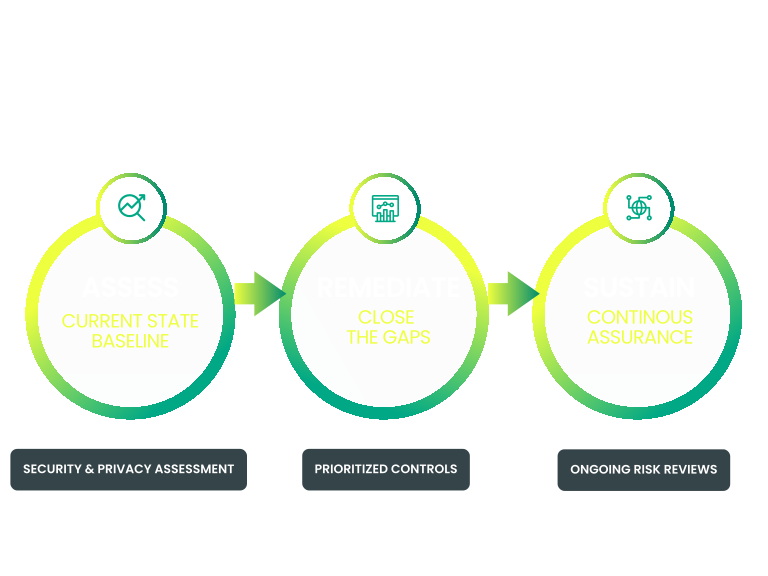
Current-state gap assessment
Penetration testing & vulnerability scans
Sensitive-data flow mapping
Third-party risk scoring
Prioritized risk register
Remediation sprints with closure criteria
Framework-aligned policy suite
Technical control validation
Risk-based system validation
Multi-framework evidence binder
Governance charter & RACI
Quarterly risk reviews
Vendor re-assessments
Mock audits & certification progression
Fractional CISO/CPO support
Build the provider-facing tools that keep ordering, results, and follow-up moving, with feedback from referring providers shaping each release.
Design portal journeys patients can finish on their own, from viewing results to paying a bill, with accessibility and multilingual support built in.
Map the systems of record and integration patterns behind client delivery before a platform decision, so the new tool fits what it has to run alongside.
Pick platforms and partners with a weighted scoring rubric built on stakeholder interviews and firm priorities, so every selection comes with a documented rationale.
Map system dependencies and technical debt at each portfolio company, then design a target architecture that supports add-on integrations and holds up in buyer diligence.
Manage technology initiatives across portfolio companies on one reporting cadence, so operating partners see status, budget, and risk without chasing each management team.
Turn the value creation plan into a technology roadmap for each portfolio company, with every initiative tied to a cost, an owner, and a hold-period milestone.
Run lab implementations in Agile sprints with clear owners, validation checkpoints, and go-live plans built around specimen volume and site schedules.
Choose LIMS, billing, and portal vendors through a structured evaluation scored against your test menu, volumes, and growth plans before an implementation timeline is set.
Build the portals and tools partners and providers use to place orders, check status, receive results, and resolve billing questions.
Move platform workloads to the cloud in planned stages, with capacity, cost, and security checks at each step so your releases keep moving.
Plan the move from licensed or on-premise software to a subscription model, covering architecture, pricing, and the customer migration path.
Run complex programs with defined scope, milestones, and owners, plus reporting that shows leaders where work stands every week.
Help staff, faculty, and volunteers adopt new systems with training and communications scaled to your team's time and budget.
Align portfolio company leadership on the changes the value creation plan requires, then track adoption so gains hold through exit.
Win partner and practice-lead buy-in early, then roll out new tools with training that fits billable schedules and client commitments.
Plan adoption for clinicians and staff around shift schedules, with training and feedback loops built into each phase of the rollout.
Run technology diligence on targets before close, flag the risks that affect valuation, and plan the integration work each add-on needs after signing.
Review the systems, data, and delivery practices of firms you plan to acquire, then combine billing, time tracking, and client records after close.
Evaluate clinical and revenue systems before close, then plan integrations that protect patient records, payer relationships, and care continuity through the transition.
Set a digital strategy for learner, member, and donor platforms that matches your mission, funding cycles, and the staff who maintain them.
Shape the product and platform roadmap, from market fit and portfolio choices to architecture and launch sequencing.
Connect IT and operations leadership across plants, warehouses, and field teams, with shared goals and clear owners for every system change.
Align technology, finance, and compliance leaders behind shared priorities, with defined owners for every platform, control, and reporting deadline.
Audit plant, distribution, and back-office systems side by side, then rank upgrades by their effect on uptime, cost, and service levels.
Review the platforms that run your programs, donors, and operations, then build a roadmap sized to your budget and staff capacity.
Assess a portfolio company's technology early in the hold period, then tie every roadmap item to the value creation plan and exit timeline.
Take stock of the systems behind client delivery, from time tracking to billing, and set priorities partners can agree on before budgets are committed.
Assess core platforms, reporting, and controls across entities and portfolios, then build a roadmap that sequences modernization around audit and reporting deadlines.
Map how clinical, billing, and patient-facing systems fit together today, then sequence upgrades so care teams absorb change one phase at a time.
Get an outside read on code quality, test coverage, and release practices for your apps, plus a testing roadmap your developers or vendors can follow.
Give patients and guardians one sign-in for results, consent, and bills, with identity checks that match your privacy policies.
Design patient-facing portals and tools that deliver results, handle consent, and verify identity in one clear experience.
Take new diagnostic tests from concept to launch with the build, billing setup, and results reporting each one needs.
Run inventory, production, distribution, and field service from one ERP, with orders, stock, and costs kept in sync across sites.
Move portfolio companies onto a common ERP using repeatable integration playbooks, with reporting designed around each company's structure at exit.
Run project accounting, time and expense, and budgets from one ERP, so partners track margin by engagement without waiting for month-end.
Select, implement, and connect the core platforms your operations run on, from ERP and LIMS to billing and cloud infrastructure.
Assess the architecture behind your learner and member platforms, then plan the changes that keep them stable as programs and audiences grow.
Plan the architecture changes a growing health platform needs, with HIPAA alignment and data flow reviewed at each layer.

Support embedded and device software from design through testing, including automated regression suites and third-party integrations.
Put AI agents to work on repetitive planning, order, and service tasks, with governance that fits the controls your operations already run.
Decide where AI fits your programs, learners, and donors, and set guardrails your board and staff can explain to the people you serve.
Rank automation and AI use cases by return, then deploy the ones that move EBITDA inside the hold period.
Add AI to your engineering workflow with guarded builds, commit-level tracing, and approval gates before code merges.
Put agents on high-volume, repeatable work in finance, HR, and client service, with a person approving every output.
Build AI workflows inside your core banking, policy, and asset platforms, with every decision logged and no side systems for auditors to chase.
Automate manual routing and queue work with AI workflows that log every decision and fit the clinical governance already in place.
Move AI agents into accessioning, results, and billing work with validation, audit trails, and human review at every step.
Measure AI readiness with modules for manufacturing, supply chain, retail, and telecom, and rank which operations workflows are ready for agents.
Score every portfolio company on the same AI readiness scale, using a module built for investor-backed and growth-stage businesses.
Rate data pipelines, engineering practices, and AI governance with a SaaS and cloud readiness module before AI reaches your product.
Assess AI readiness across finance, HR, sales, and client delivery using a general enterprise module, and rank the functions ready for agents first.
Score data, model governance, and controls with a banking and insurance readiness module, and see which AI use cases your controls can support now.
Measure AI readiness with a clinical module that scores data access, privacy safeguards, and care-team workflows before any agent goes live.
Benchmark AI readiness with a module built for diagnostics and life sciences, scoring data quality, validation needs, and workflows across the lab.
Score AI readiness across data, governance, technology, and teams with an industry-calibrated assessment, then get a prioritized plan for where AI goes first.
Link clinical and billing records so claims leave clean, denials surface early, and finance leaders see revenue by service line.
Connect clinical and billing data to improve eligibility checks, claim accuracy, denial management, and reimbursement analytics.
Connect lab instruments, LIMS, and analysis pipelines so specimen data moves from bench to report with fewer manual steps.
Put production, inventory, and sales data under one governance model so plants, warehouses, and finance teams report from matching numbers.
Put student, donor, and grant records under shared definitions and owners, so every program reports impact the same way.
Agree on KPI definitions and data models across portfolio companies so the fund compares performance on one set of numbers.
Plan the warehouse, pipelines, and governance your product data needs as customers, features, and volumes grow.
Assign one owner and one source for each client, project, and billing record across CRM, ERP, and time tracking.
Give every customer, account, and asset one governed record, with owners and definitions that hold across entities and systems.
Set governance for test, patient, and billing data across LIMS, ERP, and CRM, and use rules engines to guide specimen collection at the point of draw.
Give operating partners live dashboards and prepare data rooms with clean, consistent numbers before buyers start diligence.
Package product usage data into analytics features customers pay to use, backed by pipelines designed to scale with adoption.
Build dashboards, KPI frameworks, and analytics products that turn operational data into decisions and, where it fits, new revenue.
Organize clinical and testing data for research partnerships and new revenue, with consent tracking, de-identification, and governance set from the start.
Connect CRM to orders, inventory, and service records, so sales and support teams see account status across channels and sites.
Unify donor, alumni, and constituent records in one CRM, so development and program teams share one history for every relationship.
Configure CRM the same way across portfolio companies so pipeline and customer metrics roll up cleanly for operating partners.
Connect CRM to product usage and billing data so sales, success, and finance teams work from the same customer record.
Tie CRM to project and billing systems so partners track pipeline, utilization, and client history in one place.
Connect CRM to patient-access and referral workflows, giving outreach and service teams one view of each patient and provider relationship.
Configure CRM for provider and client accounts, connected to ordering and results data, so sales and client services see the same history.
Scan donor, learner, and member platforms for leaked secrets, outdated dependencies, and risky release habits, then close the gaps in priority order.
Give the deal team one security picture across the portfolio, built from vulnerability scans, penetration tests, and SOC 2 readiness work.
Prepare for SOC 2 and ISO 27001 with control mapping, policy updates, and evidence collection built around how your firm handles client data.
Assess platform security against HIPAA and HITECH requirements, then prioritize fixes by the risk each gap poses to patient data.
Assess patient-facing platforms against HIPAA and HITECH, then tighten identity, consent, and proxy access rules wherever patient data is exposed.
Protect patient information with access controls, consent management, and privacy practices aligned to HIPAA and state requirements.
Build compliant lab procedures for specimen logistics, reporting, and daily operations, with traceability that holds up during inspections.
Build a GRC program sized to the risks your plants, stores, and networks carry, starting from a scored maturity baseline for each operation.
Put SOX-ready governance in place at portfolio companies well before an exit or listing, with one compliance view across the fund.
Build a GRC program on the frameworks client contracts call for, and extend vendor risk reviews to every partner that touches client data.
Build a governance, risk, and compliance program that maps controls to your frameworks, assigns owners, and keeps evidence ready for audit.
Validate regulated systems against FDA and CLIA expectations with risk-based testing, traceable documentation, and audit-ready evidence.
Protect cloud platforms and sensitive data with access controls, retention rules, monitoring, and secure release practices.
Protect sensitive client information and maintain personal and financial data privacy and security standards in alignment with local, national, and international rules and regulations, including FTC Safeguards rules.
Protect sensitive patient information and maintain data privacy and security standards in alignment with HIPAA and additional local regulations.
Protect sensitive client information and Cloud-based data structures against dangerous breaches with oversight on best-in-class defense measures from our cybersecurity experts.
Tie every control to SOX, PCI DSS, or data-residency requirements, test systems in order of financial impact, and keep audit evidence current across entities.
Apply FDA Computer Software Assurance principles to LIMS and lab systems, focusing validation where patient risk is highest and keeping CLIA and CAP records current.
Confront privacy concerns and security regulations head-on with expert guidance on data privacy and security in your industry, plus additional protection in emergencies with crisis management and incident response capabilities.
Confront security and compliance head-on with expert guidance to map data risks, privacy mandates, governance frameworks, and cloud security considerations both in-country and cross-border. We engineer secure architectures to meet the highest standards of quality and privacy across digital utilities and applications.
Maintain a clean chain of custody from accessioning to result release, with SOPs and records ready for CAP and state inspections.
Assess security posture, close control gaps, and prepare evidence for the frameworks your customers and auditors require.
Get a scored view of your posture across every framework in scope, with a risk register that ranks each gap by severity and a data-flow map that shows where sensitive records move.
Federate sign-on across internal teams and outside partners, verify identities before records open, and apply attribute-based rules so each user sees only what their role allows.
Assemble policies, control tests, and validation records into an evidence binder built through a compile, validate, release cycle, with risk-based testing focused where it can make the biggest impact.
Run quarterly risk reviews, tiered vendor re-assessments, and annual policy refresh on a certification path that grows with your risk profile, overseen by a standing risk committee and fractional CISO/CPO support.